


The UK is becoming increasingly familiar with hot weather events. While the summer of 2022 saw the highest ever recorded temperature of 40.3°C, heatwave events in the years since have come pretty close to beating this.
Most drivers are well drilled on winter car maintenance. But summer and specifically the heatwave conditions that have become more frequent create a different and in many ways more damaging set of problems for vehicles.
After all, heat does not announce its damage the way ice does. It works gradually, degrading fluids, stressing tyres, accelerating battery decline and choking the systems that are supposed to keep your car running comfortably. The result is a surge in summer breakdowns that catches British drivers off guard every year.
This guide from Filter Services covers everything that should be checked on your vehicle as soon as a heatwave is forecast.
Coolant & The Cooling System
The cooling system is the most important line of defence against heat damage and it works hardest in the worst possible conditions. That is, slow moving traffic on a scorching day, with the AC adding to the engine load. A failing cooling system in a heatwave is not just an inconvenience. It can result in a blown head gasket, warped engine components and repair costs that run into thousands.
Coolant, a 50/50 mix of antifreeze and water, absorbs heat from the engine and releases it through the radiator. Over time, coolant degrades and loses its ability to regulate temperature effectively. Old or dirty coolant can also cause corrosion and sludge build-up in the radiator, blocking the fine channels that dissipate heat.
What to check:
- Coolant level: check the translucent reservoir tank when the engine is cold. The level should sit between the min and max markers. Never open the radiator cap or coolant reservoir on a hot engine, as the system is pressurised and can cause serious burns
- Coolant condition: healthy coolant is typically bright green, blue or orange depending on the type. Brown or murky coolant is a sign of contamination and needs flushing
- Hoses and clamps: radiator hoses should be firm with no bulging, cracking or soft spots. A split hose can drain the system rapidly
- Radiator fins: insects, grime and debris accumulate on the front of the radiator and reduce its ability to dissipate heat. A gentle rinse with low-pressure water clears blockages without bending the fins
- Radiator cap seal: a perished rubber seal on the cap means the system cannot hold the correct pressure, which lowers the boiling point of the coolant. It is an inexpensive part that is worth inspecting
If your temperature gauge climbs into the red or your warning light comes on while driving, pull over safely, turn off the engine and wait at least 30 minutes before checking anything under the bonnet. Do not continue driving an overheating car.
Engine Oil & The Oil Filter
Engine oil does two essential jobs: it lubricates moving parts to prevent metal-on-metal wear and it helps carry heat away from the engine. In summer, both functions come under greater pressure.
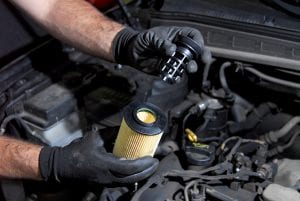
Heat accelerates oil degradation. At elevated temperatures, oil loses viscosity more quickly, becomes less effective as a lubricant and accumulates contaminants at a faster rate. The oil filter works alongside the oil, removing those contaminants before they can recirculate through the engine. A filter that is saturated or past its service life cannot do that job, which means dirty, degraded oil is being pushed through engine components that are already under thermal stress.
If an oil change is coming up, do not delay it until after the summer. Check the dipstick for level and condition. Oil that looks dark, gritty or has a strong burnt smell needs changing. The filter should always be replaced at the same time as the oil.
What to check:
- Oil level: pull the dipstick, wipe it clean, reinsert and check that the level falls between the min and max marks
- Oil condition: fresh oil is amber. Very dark or black oil with a gritty texture is overdue for a change
- Service interval: if you are within a few thousand miles of your scheduled oil change, bring it forward rather than waiting
- Oil filter: always replace alongside the oil. A clogged filter bypasses and allows unfiltered oil to circulate
Cabin Air Filter & Air Conditioning
Of all the items on this list, the cabin air filter is the one most consistently overlooked by drivers preparing for summer. It is also one of the most directly responsible for whether your car feels bearable in a heatwave.
The cabin air filter cleans the air entering the car through the HVAC system, removing dust, pollen, exhaust particles and other contaminants. Over time, it becomes clogged and when it does, airflow through the system drops significantly. The practical result is weak airflow from the vents, an AC system that struggles to cool the cabin and a blower motor working harder than it should to push air through a blocked filter.
Many drivers assume their AC has developed a mechanical fault when the actual problem is a filter that has not been replaced in years. A new cabin air filter is a fraction of the cost of an AC repair and in most vehicles, it can be changed in minutes without tools.
Beyond comfort, there is a safety consideration. Driver fatigue increases measurably in extreme heat and a properly cooled cabin makes a genuine difference on long summer journeys.
Signs your cabin air filter needs replacing:
- Weak airflow from the vents even at full fan speed
- AC takes much longer than usual to cool the cabin
- Musty or stale smell when the ventilation is running
- Visible dust accumulation on the dashboard
- Foggy or slow-to-clear windows
Most manufacturers recommend replacing the cabin air filter every 12,000 to 15,000 miles or once a year, whichever comes first. Drivers in urban areas with high traffic density, or those who drive through high-pollen environments, should replace it more frequently. If your car has not had a cabin air filter change in the last 12 months, it is worth checking before summer properly arrives.
On the AC system itself, if the air is warm or significantly weaker than expected after replacing the filter, a refrigerant top-up may be needed. Most vehicles lose around five per cent of refrigerant per year naturally. A regas is a straightforward service that most garages can carry out.
Engine Air Filter
The engine air filter cleans the air entering the combustion process, protecting internal engine components from dust and debris. In normal conditions, a blocked engine air filter leads to reduced fuel economy and sluggish acceleration. In summer, when the engine is already running under greater thermal load, a restricted air filter compounds the problem by limiting the clean airflow the engine needs to run efficiently.
A clogged engine air filter can push running temperatures higher, reduce the engine’s ability to cool itself and increase the risk of overheating in stop-start traffic. It is a simple check and an inexpensive filter to replace.
What to check:
- Visual inspection: most engine air filters are housed in a plastic box near the top of the engine. Remove the lid and check the filter. If it is visibly grey, clogged with debris or compressed, it needs replacing
- Service mileage: engine air filters are typically changed every 12,000 to 15,000 miles. Urban driving with higher pollution levels accelerates the build-up
Tyres
Tyres are where the physics of a heatwave become most immediately dangerous. Hot tarmac acts as a giant radiator, absorbing heat until road surface temperatures far exceed the air temperature. During a UK heatwave, road surfaces can reach 65 to 70 degrees Celsius in direct sunlight, well above the threshold at which bitumen begins to soften and rut.
As tyres roll over this surface at motorway speeds, the internal friction generates additional heat. Sustained overheating weakens the rubber structure, causes microscopic cracking in the sidewalls and increases the risk of a blowout significantly. An under-inflated tyre compounds this dramatically: the sidewalls flex heavily as the tyre rolls, generating internal friction and heat that can cause a sudden structural failure on a hot road.
Tyre pressure also rises naturally as ambient temperature increases. For every 10 degrees Celsius increase in temperature, tyre pressure rises by approximately 1 PSI. A tyre correctly inflated on a cool morning can be over-inflated by midday on a hot day, reducing the contact patch with the road and making the tyre more vulnerable to blowouts on rough surfaces. Do not let air out of hot tyres, as this leads to dangerous under-inflation once temperatures drop.
What to check:
- Pressure: always check when the tyres are cold, before the car has been driven that day. Use the manufacturer’s recommended pressure from the door sill sticker or the owner’s manual
- Tread depth: the legal minimum is 1.6mm across the central three-quarters of the tyre. Lower tread in summer means longer stopping distances, particularly if a sudden rain shower follows a dry spell
- Sidewall condition: look for bulges, cracks or cuts. These are signs of structural weakness that hot road conditions will exploit
- Spare tyre: the boot can reach extreme temperatures in summer. Check the spare is inflated and in usable condition before a long journey
Battery
This one surprises most drivers: heat is harder on car batteries than cold. Winter gets the blame because that is when the symptoms show up, but the damage that causes a flat battery in January was often done the previous summer.
Under the bonnet, temperatures regularly exceed 60 degrees Celsius when the outside air is 30 degrees. At that heat, the electrolyte fluid inside the battery, a mixture of acid and water, evaporates faster than normal. As the fluid level drops, the internal plates are exposed to air and begin to corrode. Heat also accelerates the formation of lead sulphate crystals on the plates, which permanently reduces the battery’s capacity. An overworked alternator, running harder to meet electrical demands on a hot day with the AC and fans running, adds further stress.
A battery that has been weakened by summer heat may still start the car reliably in August. Come the first cold morning of autumn, when a battery needs more cranking power, it fails. The summer damage reveals itself at the worst time.
What to check:
- Age: most car batteries last three to five years. If yours is approaching or beyond that range and has not been tested recently, do it before summer
- Terminals: look for white or blue corrosion around the terminals. Clean terminals ensure a good electrical connection
- Warning signs: slow engine cranking on start-up, dimming headlights or electrical components behaving erratically are all signals a battery is weakening
- Professional test: most garages and battery suppliers offer a free load test that gives an accurate picture of battery health and remaining capacity
Brakes & Brake Fluid
Brake fluid is hygroscopic, which means it absorbs moisture from the air over time through the flexible brake hoses and the reservoir cap. This matters in summer because absorbed moisture lowers the fluid’s boiling point. Braking generates significant heat, particularly on long descents, during heavy traffic or when carrying a full load. If the brake fluid has absorbed enough moisture, that heat can cause the fluid to boil inside the brake lines.
When brake fluid boils, it creates gas bubbles in the hydraulic system. Unlike liquid, gas is compressible, which means pressing the brake pedal compresses the bubbles rather than generating braking force. The pedal goes soft or goes to the floor. In severe cases this becomes a total loss of braking, a condition known as vapour lock. It is rare in normal UK driving, but the risk increases with old fluid, heavily loaded vehicles and sustained hard braking on long descents in summer heat.
Most manufacturers recommend replacing brake fluid every two years regardless of mileage, because the moisture absorption that reduces its boiling point is time-dependent rather than distance-dependent.
What to check:
- Fluid age: check your service records. If brake fluid has not been replaced in more than two years, book it in
- Pedal feel: a spongy or inconsistent brake pedal can indicate moisture contamination in the fluid
- Fluid level: the reservoir is usually a small translucent pot near the firewall. The level should sit between min and max. A low level may indicate pad wear or a leak
Visibility: Wipers, Washer Fluid & Windscreen
Visibility problems in summer are different from winter. Pollen coats windscreens quickly during peak season, insects accumulate on the glass at motorway speeds and the low sun angles of summer mornings and evenings create glare that dirty glass amplifies significantly.
Wiper blades that performed adequately in winter often deteriorate in spring as heat and UV exposure dry out the rubber. A blade that streaks rather than clears is a hazard when driving into a low sun, or when a sudden summer thunderstorm arrives after a dry spell and leaves a film of oils and debris across the screen.
Washer fluid is more important in summer than most drivers appreciate. Plain water evaporates quickly, does not cut through insect residue effectively and can leave smears that catch the light. A proper summer screenwash concentrate handles the mix of dust, pollen and insect debris that builds up on the glass during warm months.
What to check:
- Wiper blades: run them on a wet screen and watch for streaking, skipping or smearing. Blades typically need replacing every six to twelve months
- Washer fluid: top up with a summer-formulated screenwash that cuts through insect debris and pollen
- Windscreen condition: existing chips or cracks are made worse by the expansion and contraction of glass in extreme heat. A chip that has been stable for months can propagate into a crack during a heatwave. Get chips repaired before summer temperatures peak
- Screen cleanliness: the inside of the windscreen attracts an oily film over time that dramatically worsens sun glare. Clean both surfaces
The Pre-Heatwave Checklist:
Run through these before the temperature peaks and you significantly reduce the risk of a breakdown, an expensive repair or being stranded in the heat:
- Coolant: level, condition, hoses and radiator fins
- Engine oil and oil filter: level, condition and proximity to service interval
- Cabin air filter: replace if over 12 months old or if AC performance has dropped
- Engine air filter: inspect and replace if visibly clogged
- Tyres: cold pressure, tread depth, sidewall condition and spare
- Battery: age, terminals and a load test if over three years old
- Brake fluid: check the last replacement date and pedal feel
- Wipers, washer fluid and windscreen: blades, fluid level and any existing chips
Summer maintenance does not require a full service. Most of these checks take minutes and can be done at home. The ones that cannot such as a battery load test, a brake fluid change and an AC regas, are straightforward garage jobs that are far cheaper booked in advance than dealt with at the roadside.
Need To Replace Your Vehicle Filters In Time For Summer?
If you need to replace your cabin air filter, engine air filter or oil filter ahead of summer, you can browse a wide range of filters right here on our website.
Shop the leading brands including Fleetguard, Donaldson, Mann and Hifi, for cars, vans, HGVs and agricultural vehicles.
Need any help selecting the right filter for your vehicle? Please send us a message or give us a call on 01246 802 822.